Welcome to the
Diocese of Our Lady,
Queen of Martyrs
Reformed Catholic Church
Click to discover more
Our Bishop
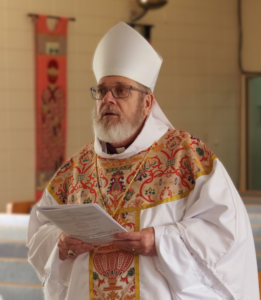
The Most Reverend William R. Cavins
The Most Rev. William R. Cavins is the founding bishop of the Diocese of Our Lady, Queen of Martyrs in the Reformed Catholic Church. His ministry reflects a deep commitment to inclusive worship, pastoral care, and social justice, with a vision of a Church that welcomes all and proclaims Christ’s love in word and action. Since 2020, he has served as pastor of Abiding Presence Faith Community in Orlando, Florida.
Bishop Cavins was ordained to the Diaconate on June 15, 1996, the Presbyterate on November 25, 2006, and consecrated as a Bishop on January 26, 2013. His episcopal motto, “In Christ’s Love,” expresses his dedication to compassion and reconciliation in every aspect of ministry.
He is the author of several devotional and theological works available on Amazon, including Beloved and Bold: Prayers for Queer Faith, Justice, and Joy, Come, O Come, Emmanuel, and Journeys of the Heart: Interfaith Prayers for Immigrant Lives. Bishop Cavins has also contributed to Extraordinary Catholics magazine. His writings emphasize prayer, justice, and the transformative power of grace.
Beyond his publications, Bishop Cavins is actively engaged in ecumenical dialogue and advocacy for marginalized communities, working to expand the Church’s presence and mission across the United States.
From the Bishops desk
Diocese of Our Lady, Queen of Martyrs
Reformed Catholic Church
5330 Poinsetta Avenue
Winter Park, Florida 32792
OLQM24@gmail.com
www.queen-of-martyrs.com
March 12, 2026
A Statement of Solidarity with Temple Israel
Today we learned with deep concern that the community of Temple Israel was attacked. News like this grieves the conscience of every person of faith. Houses of worship are meant to be sanctuaries of prayer, learning, and community. When one is threatened or harmed, all people of faith feel the wound.
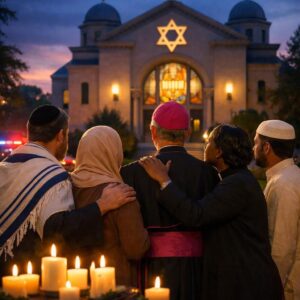
On behalf of the Diocese of Our Lady, Queen of Martyrs of the Reformed Catholic Church, I express our solidarity with the clergy, leadership, and members of Temple Israel. Please know that you are not alone. Your neighbors of many faiths stand with you in prayer and in resolve.
Antisemitism is not only an attack on Jewish communities. It is an assault on the moral fabric of society. The history of the world has shown us the terrible consequences of allowing hatred toward Jewish people to grow unchecked. Every generation therefore bears the responsibility to confront it clearly and without hesitation.
Scripture reminds us: “Seek peace and pursue it” (Psalm 34:14). Pursuing peace requires more than words. It calls us to defend the dignity and safety of our neighbors and to refuse the normalization of hate in any form.
Today we hold the congregation of Temple Israel in prayer. We also renew our commitment to building communities where Jewish, Christian, Muslim, Hindu, humanist, and all people of goodwill can worship, gather, and live without fear.
May courage overcome hatred.
May solidarity overcome division.
And may peace dwell among all people.
In Christ’s Love,
✠ William R. Cavins
Bishop of Our Lady, Queen of Martyrs
Reformed Catholic Church
Diocese of Our Lady, Queen of Martyrs
Reformed Catholic Church
5330 Poinsetta Avenue
Winter Park, Florida 32792
OLQM24@gmail.com
www.queen-of-martyrs.com
March 12, 2026
Statement on the Shooting at Old Dominion University, Norfolk, Virginia
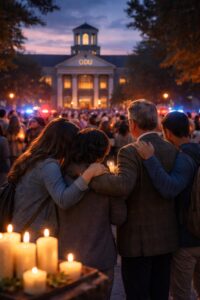
The violence that occurred today at Old Dominion University has shocked and saddened communities across the nation. A shooting on campus left one person dead and others injured before the attacker was stopped by students who intervened.
Universities exist to be places of learning, discovery, and hope for the future. When violence enters those spaces, it wounds not only those directly affected but also the wider community that believes education should be a sanctuary for young people and those who teach them.
We remember in prayer the life that was lost, including the instructor who died in the attack, and we pray for those who were wounded and for their families. We also recognize the courage shown by the students who acted quickly and bravely, preventing what could have been an even greater tragedy.
Scripture reminds us: Blessed are the peacemakers, for they shall be called children of God (Matthew 5:9). In moments like this, we are reminded that peacemaking is not only a spiritual calling but also a social responsibility.
Violence, extremism, and hatred, whatever form they take, have no place in a society that values human dignity. The tragedy in Norfolk calls all of us to renew our commitment to communities where disagreement does not become dehumanization and where differences are not answered with violence.
On behalf of the Diocese of Our Lady, Queen of Martyrs of the Reformed Catholic Church, I extend our prayers and solidarity to the students, faculty, staff, and families of Old Dominion University, as well as to the wider Norfolk community.
May God comfort the grieving,
strengthen the wounded,
and guide us all toward the work of peace.
In Christ’s Love,
✠ William R. Cavins
Bishop of Our Lady, Queen of Martyrs
Reformed Catholic Church
Diocese of Our Lady, Queen of Martyrs
Reformed Catholic Church
5330 Poinsetta Avenue
Winter Park, Florida 32792
OLQM24@gmail.com
www.queen-of-martyrs.com
January 18, 2026
A Pastoral Letter for the Sunday of Christian Unity 2026: One Body, One Spirit, One Hope
Dear sisters and brothers in Christ,
Grace and peace to you in the name of our Savior Jesus Christ.
Each year, the Church pauses to observe the Sunday of Christian Unity, a moment given to prayer, repentance, and renewed commitment to the unity for which Christ himself prayed: “that they may all be one… so that the world may believe” (John 17:21). In 2026, we eceive this call in a time of profound political polarization, social unrest, economic anxiety, and growing mistrust among peoples and nations. These realities weigh heavily on our communities and often find their way into our churches, families, and relationships.
It is precisely in such a time that the apostolic proclamation rings with renewed urgency: “There is one body and one Spirit, just as you were called to the one hope of your calling” (Ephesians 4:4).
The Church is not a collection of competing factions, nor a reflection of the divisions of the world. We are, as Saint Paul reminds us, “one body in Christ, and individually members one of another” (Romans 12:5). This unity is not achieved by uniformity of opinion, culture, or political allegiance, but by our common incorporation into Christ through baptism. “For in
the one Spirit we were all baptized into one body, Jews or Greeks, slaves or free” (1 Corinthians 12:13).
In a society that profits from division and thrives on fear of the other, Christians are called to embody a different reality. When we allow partisan identities or ideological loyalties to outweigh our baptismal identity, we wound the Body of Christ. Unity does not mean the absence of disagreement; it means refusing to let disagreement become contempt, exclusion, or violence.
Our unity is not a human achievement but a gift of the Holy Spirit. The same Spirit who hovered over the waters of creation (Genesis 1:2), descended upon Jesus at his baptism (John 1:32–33), and was poured out upon the Church at Pentecost Acts 2:1–4) continues to breathe life into the Church today.
Saint Paul exhorts us to “live in a manner worthy of the calling you have received, with all humility and gentleness, with patience, bearing with one another in love, making every effort to maintain the unity of the Spirit in the bond of peace” (Ephesians 4:1–3). The Spirit draws us away from fear and hostility and leads us toward reconciliation, truth, and courage.
Where the Spirit is at work, walls are lowered, listening is restored, and hope is rekindled.
Christian unity is sustained by hope, not optimism rooted in political outcomes or social stability, but hope grounded in the faithfulness of God. “Hope does not disappoint us, because God’s love has been poured into our hearts through the Holy Spirit that has been given to us” (Romans 5:5).
In times of turmoil, the temptation is strong to despair, to withdraw, or to mirror the anger of the world. Yet we are a people who confess that Christ is risen, that death does not have the final word, and that God is reconciling all things in Christ (Colossians 1:19–20). This hope empowers us to remain engaged without becoming hardened, to speak truth without
hatred, and to work for justice without surrendering to cynicism.
On this Sunday of Christian Unity, I invite every member of our community to pray earnestly for the healing of divisions within the Church and throughout the world. Pray for those with whom you disagree. Pray for leaders entrusted with power. Pray for the courage to be instruments of peace. As the prophet reminds us, “The work of justice will be
peace, and the effect of justice, quietness and trust forever” (Isaiah 32:17).
May our shared faith in Christ move us beyond fear toward fellowship, beyond division toward communion, and beyond despair toward hope. United as one body, animated by one Spirit, and sustained by one hope, may we bear faithful witness to the reconciling love of God in a fractured world.
In Christ’s Love,
✠ William R. Cavins
Bishop of Our Lady, Queen of Martyrs
Reformed Catholic Church
Diocese of Our Lady, Queen of Martyrs
Reformed Catholic Church
5330 Poinsetta Avenue
Winter Park, Florida 32792
OLQM24@gmail.com
www.queen-of-martyrs.com
January 18, 2026
Dear Beloved in Christ,
We as a Christian people know the truth of song, how a melody can soften grief, how a chorus can knit strangers into friends, how a hymn can carry us when words fall short. In the Church, music is not a decorative extra; it is a means of grace, a Spirit-given way God teaches, consoles, corrects, and gathers us into communion. The psalmist invites us: “Sing
to the LORD a new song; sing to the LORD, all the earth” (Psalm 96:1).
Today, I write to you about another truth we must face: the enduring sin of racism. A quote circulating in justice circles says, “Racism does whatever it needs to do to perpetuate itself.” This statement is painfully accurate. Racism is not static; it adapts, shifting from overt exclusion to subtle systems that preserve privilege and perpetuate harm. It infiltrates
economics, health care, housing, education, policing, and even political rhetoric. It is a sin that wounds the Body of Christ and denies the image of God in our siblings.
Across our nation, racial wealth gaps remain staggering. Federal Reserve data shows that White households hold nearly eight times the wealth of Black households, even as overall wealth grows. Housing discrimination’s legacy persists in neighborhoods once redlined, where property values lag and environmental hazards abound. Health disparities
continue: the CDC has declared racism a public health threat, citing higher disease burdens and shorter life expectancy among communities of color. Education gaps, algorithmic bias, and discriminatory hiring practices reinforce inequity.
Politically, racism adapts through restrictive voting laws, gerrymandering, and rhetoric that makes scapegoats immigrants and communities of color. Court decisions have weakened protections once guaranteed by the Voting Rights Act, widening turnout gaps.
Policing disparities remain entrenched, with disproportionate stops, searches, and use of force against Black Americans.
This is what the quote means: racism morphs to survive. It shifts tactics but keeps its grip.
The Word of God is clear:
“Ah, you who make iniquitous decrees… to turn aside the needy” (Isaiah 10:1–2).
“[God] has anointed me to bring good news to the poor… to let the oppressed go free” (Luke 4:18–19).
“My siblings, show no partiality” (James 2:1).
Racism is incompatible with the Gospel. It contradicts the Eucharistic vision of one Body (1 Corinthians 10:17) and the catholicity of the Church, which embraces every tribe and tongue (Revelation 7:9). As Reformed Catholics, we are called to confess this sin, reform unjust structures, and embody Christ’s reconciling love.
Beloved, faith without works is dead (James 2:17). Here are commitments I urge every parish and household to embrace:
Resist Dehumanizing Rhetoric: Speak truth against language that demeans or divides.
Truth-Telling and Formation: Preach and teach that racism is sin, personal and structural. Host listening sessions where those harmed by racism share their stories.
Inclusive Worship: Let our liturgies reflect God’s kingdom, multilingual, multicultural, merciful. Confess societal sins and pray for justice.
Health Equity: Partner with clinics and advocate for accessible care in marginalized communities.
Housing Justice: Support fair housing, anti-displacement efforts, and environmental protections for vulnerable neighborhoods.
Fair Work and Education: Audit hiring practices for bias; invest in tutoring and scholarships for under served schools.
Voting Rights: Offer nonpartisan voter education and assistance; advocate for laws that protect equal access to the ballot.
Public Safety Reform: Support community-based alternatives to policing and insist on transparency and accountability.
Resist Dehumanizing Rhetoric: Speak truth against language that demeans or
divides.
These actions are not optional, they are Gospel imperatives. “Let justice roll down like waters, and righteousness like an ever-flowing stream” (Amos 5:24).
The statement we began with is sobering: racism adapts to survive. But grace adapts too. The Spirit is resourceful, raising up truth-tellers and reformers. We see signs of hope: public health declarations naming racism as a crisis, court rulings restoring fair maps, and communities organizing for equity.
“Do not be conformed to this world but be transformed by the renewing of your minds” (Romans 12:2). Beloved, transformation is possible—through truth, sacrament, service, and civic love.
Please join me in praying…
God of justice and mercy,
You create each person in your image and call us one Body.
Renew our minds and reform our structures.
Heal those harmed by racism; convert hearts that perpetuate it.
Give us courage to do justice, love mercy, and walk humbly with you (Micah 6:8).
Make our parishes schools of grace and laboratories of equity,
until your justice rolls down and all your children flourish.
Amen.
In Christ’s Love,
✠ William R. Cavins
Bishop of Our Lady, Queen of Martyrs
Reformed Catholic Church
Diocese of Our Lady, Queen of Martyrs
Reformed Catholic Church
5330 Poinsetta Avenue
Winter Park, Florida 32792
OLQM24@gmail.com
www.queen-of-martyrs.com
January 1, 2026
Dear People of God,
As we begin a new year, we are invited to renew our commitment to the Gospel and to the sacred work of compassion. January is a time of reflection and resolve, a moment to ask how we will live more faithfully, more justly, and more lovingly in the year ahead.
In this spirit, I call our attention to those who begin this year without shelter, warmth, or security: our brothers and sisters experiencing homelessness. Their suffering is not distant from us; it is a cry that echoes in the heart of Christ, who was born in a borrowed stable and lived among the poor.
The Western Patriarch Francis reminds us:
“We are called to find Christ in them, to lend our voice to their causes, but also to be their friends, to listen to them, to understand them and to welcome the mysterious wisdom which God wants to communicate to us through them.” (Evangelii Gaudium, 198)
To minister to the homeless is to embrace a theology of presence. It is not only about providing food or shelter, but about restoring dignity, building relationships, and advocating for justice. It is about seeing Christ in every person and allowing that encounter to transform us.
This month, I urge every parish, mission, and ministry to take concrete steps in service to the homeless. Host a community meal, organize a clothing drive, partner with local shelters, or simply spend time listening to someone who is unhoused. Let our actions be rooted in love, not pity, and guided by the Spirit of Christ who walks with the poor.
Let us also begin this year with trust in God’s plan, releasing anxiety and embracing the future with gratitude. May praying with the Word of God nourish our lives and guide us to build a more fraternal Church, one that welcomes the marginalized and seeks their flourishing.
May we be a Church that not only speaks of love, but lives it, especially among those most in need.
In Christ’s Love,
✠ William R. Cavins
Bishop of Our Lady, Queen of Martyrs
Reformed Catholic Church
Explore Our Parishes
Click to discover more